
A vessel in dynamic positioning mode holds station within a few meters of a target point,
above an oil well, alongside a wind-turbine foundation, beside a platform, using only its
own thrusters. There is no anchor and no mooring line. Position-keeping is provided exclusively by
a closed-loop chain of sensors, controllers, switchboards, drives and prime movers, and the entire
chain depends on uninterrupted electrical power.
Loss of power means loss of position. For a drillship over a live well, a dive-support vessel above a saturation diver, or a cable-laying ship paying out armoured cable, the consequences range from expensive downtime to environmental damage and risk to human life. Class societies translate this operational reality into DP-1, DP-2 and DP-3 notations with progressively stricter redundancy requirements that the electrical protection system has to meet without compromise.
This is where SYMAP® comes in. Our protective relays are designed from the ground up for selective tripping, isolate exactly the faulty section, keep everything else energised, with the response times and inter-device coordination that DP class requires.
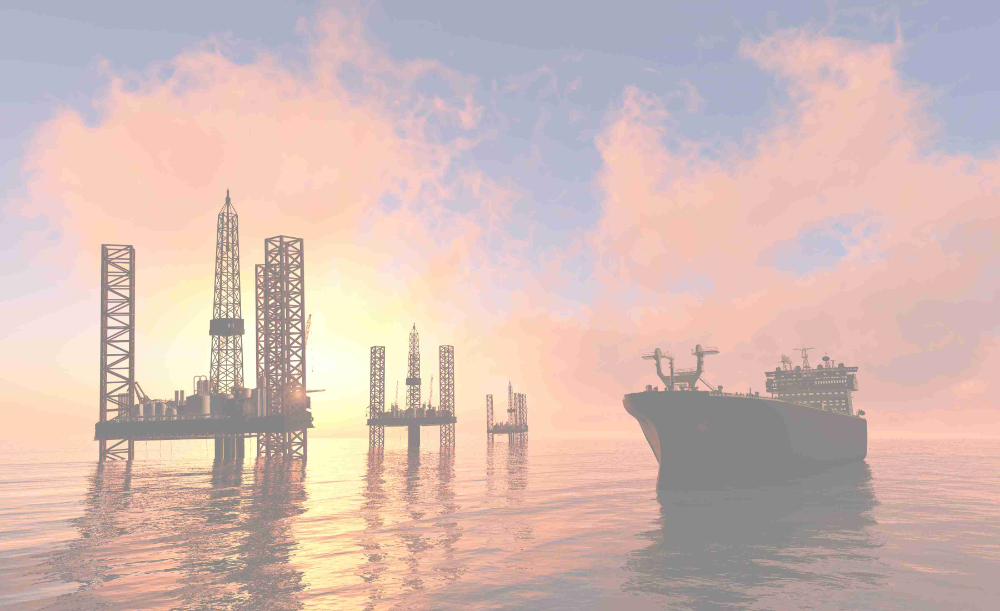
DP class notations are defined in IMO MSC/Circ.645 and rule sets of the major classification societies (DNV, ABS, LR, BV, RINA, ClassNK, RMRS, CCS). Each step up the class hierarchy adds redundancy obligations that propagate down to relay-level protection design.
Single failure tolerance not required. Loss of position acceptable on a single component failure.
Typical vessels: small PSVs, light construction support, near-shore operations where consequence of position loss is limited.
Protection role: robust selective tripping, fast clearance of short-circuits, simple bus-tie coordination.
Tolerant to any single active failure no loss of position from one fault in any active component (generator, switchboard section, cable, controller, thruster drive).
Typical vessels: drillships, AHTS, offshore wind installation vessels, dive-support vessels, cable layers.
Protection role: split-bus operation with closed bus-tie option, fast inter-relay communication, fault ride-through, generator auto-disconnect with blackout prevention.
Tolerant to any single failure including fire or flooding in any single watertight compartment. Engine rooms and switchrooms physically separated and galvanically isolated.
Typical vessels: deepwater drillships, heavy-lift offshore vessels, accommodation units in harsh environments.
Protection role: fully redundant, physically separated protection systems with independent measurement and tripping paths; no shared single point of failure between bus sections.
A short-circuit on one feeder must be cleared by the local breaker, not by the upstream generator breaker. Time-current grading alone is rarely fast enough for low-impedance networks with multiple parallel generators. SYMAP® combines instantaneous current criteria with inter-relay blocking signals over IEC 61850 GOOSE giving directional, zone-selective tripping in a few milliseconds.
When the network is operating close to its capacity and a generator drops out, every millisecond counts. The remaining generators must absorb the load without tripping on over-current or under-frequency. SYMAP® provides fast load-shedding logic generator auto-disconnect with adaptive thresholds, and seamless coordination with the power-management system.
DP-2 vessels often run with closed bus ties for fuel efficiency, yet must be able to open the bus tie within a single fault cycle if a fault threatens to propagate. SYMAP® relays exchange directional and differential information across the bus tie and trip the tie breaker before the fault current crosses to the healthy side.
Voltage dips during a fault must not cause healthy thruster drives to trip on under-voltage. Our protection logic distinguishes between transient faults (ride through) and sustained ones (trip), keeping the propulsion system online while the fault is being cleared elsewhere.
A single Ethernet failure cannot be allowed to disable selectivity logic. SYMAP® supports PRP and HSR redundancy protocols, dual-network configurations and ring topologies so inter-relay messaging stays alive through any single network failure.
Every DP installation has to pass class FMEA, FAT and a sea-trial DP-FMEA proving test. We have delivered protection systems that have successfully completed these tests for all major classification societies, and we provide engineering support throughout commissioning.
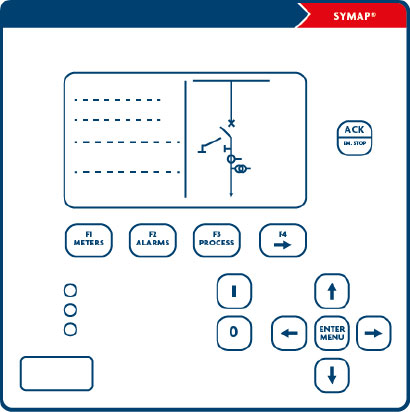
The flagship multifunctional protection and bay-control relay for medium- and low-voltage marine switchboards. Generator, feeder, bus-tie and incomer variants (G, BCG, ECG, DC) cover every position in a DP switchboard.
Brochure (PDF)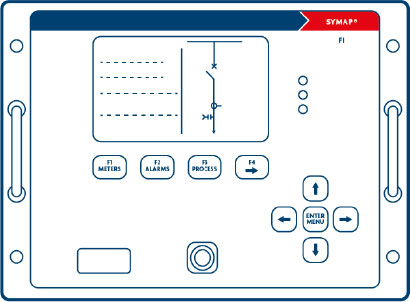
Compact retrofit variant with the same protection algorithms in a slimmer housing. Ideal for DP retrofit projects where panel space is fixed and existing wiring has to stay.
More info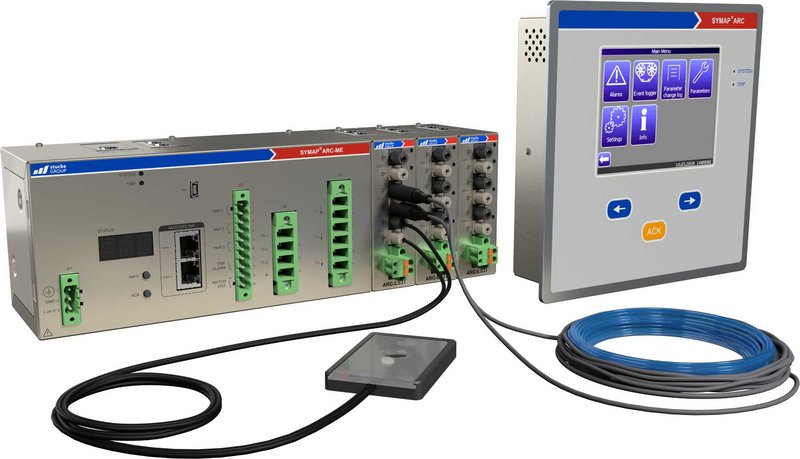
Arc-fault protection with sub-2 ms tripping. On DP-2 and DP-3 switchboards, arc protection drastically reduces damage and downtime if a flashover does occur.
Product page


